
OSP Route Selection: The Real Cost Model Behind Underground vs. Aerial
A per-foot cost comparison hides most of what actually determines whether an aerial or underground route finishes on schedule and on budget. Here's the data that belongs in the decision instead.
Pathworks Engineering Team
Every outside plant design eventually arrives at the same fork in the road: bore it, trench it, or hang it on existing poles. In the earliest stages of a project, this decision usually gets framed as a simple unit-cost comparison: dollars per foot for conduit and vault installation versus dollars per foot for aerial strand and lashing. That framing feels reasonable on a proposal spreadsheet, and it is exactly why so many outside plant (OSP) budgets come apart during construction. Unit cost per foot is the least informative number in the entire comparison, because it captures none of the variables that actually determine whether a route finishes on schedule and on budget.
This article works through the cost and risk variables that a unit-cost comparison hides, the specific engineering and permitting data that should inform a route decision before it is locked into a bid package, and why route selection belongs firmly in the design phase rather than being left to a general contractor to sort out after mobilization.
What the Unit-Cost Comparison Actually Hides
A per-foot aerial cost estimate assumes that pole attachment proceeds smoothly and on a predictable schedule. In practice, it rarely does. Under the FCC's pole attachment rules, an incumbent pole owner has up to 45 days to complete a survey and issue a make-ready estimate for a standard attachment request, and the make-ready construction window that follows can run considerably longer once existing attachers exercise their own sequencing rights under the applicable tariff or pole attachment agreement. A route that looks like the cheaper option on a spreadsheet can lose eight to twelve weeks to make-ready sequencing alone before a single strand of fiber goes into the air: time that a properly permitted directional bore route does not spend waiting on a third party's survey queue.
Underground construction carries the inverse problem: the per-foot number looks worse on paper until the ongoing operational exposure of aerial plant is priced into the comparison. Storm damage, vehicle strikes, and vegetation contact are consistently the leading causes of aerial plant outages in utility and telecom reliability reporting, and every one of these events carries a truck-roll cost, a customer-facing outage, and in some cases a liability exposure that never appears in the original per-foot construction estimate. A route that is five percent more expensive to build underground can easily be cheaper over a fifteen-year operating horizon once these avoided costs are modeled honestly.
The Variables That Actually Decide the Comparison
Soil classification and rock probability. A proposed route through Class III or IV soils, using standard boring contractor classification tables, can multiply directional-bore production rates by a factor of three to five compared with the same length of route through Class I soils. A design package that does not reference geotechnical borings or prior utility construction records for the corridor is effectively pricing the underground option blind, and that blind pricing shows up later as a change order once the boring contractor hits rock that nobody flagged at the estimating stage.
Existing joint-trench and dig-once opportunities. Many municipalities maintain dig-once ordinances that require conduit installation to be offered to other utilities and communications providers whenever a road-opening project is scheduled. A fiber route timed to coincide with a scheduled municipal repaving project, a water main replacement, or another utility's planned trench opening can reduce trenching cost substantially compared with an isolated bore performed on its own schedule. Capturing this opportunity requires the design team to be actively tracking capital improvement plans and public works schedules at the route-planning stage: not discovering after the fact that the city repaved the exact corridor six months before the fiber project broke ground.
Attachment congestion on existing pole lines. NESC Rule 235 governs minimum clearances between communication space and power space on a joint-use pole, as codified in IEEE C2, the National Electrical Safety Code. A pole line that is already at or near capacity in the communication space forces a make-ready sequence that frequently includes pole replacement rather than simple strand relocation: a cost and timeline impact that can erase aerial construction's apparent cost advantage on that specific span even when the rest of the route remains straightforward.
Restoration specification differences by jurisdiction. Full-width pavement restoration requirements versus trench-patch-only requirements can shift the effective cost of an underground route by a meaningful margin depending on the specific municipality's standard construction details. This is a line item that has to be priced against each jurisdiction's actual restoration standard, not assumed from a regional average pulled from a different project's cost history.
Environmental and wetland permitting exposure. Routes crossing streams, wetlands, or other jurisdictional waters can trigger Clean Water Act Section 404 permitting requirements administered by the U.S. Army Corps of Engineers, adding a permitting track with its own timeline that is entirely independent of the municipal right-of-way process. A route alternative that avoids a wetland crossing by adding a few hundred feet of length frequently beats the "shorter" route once the environmental permitting timeline is honestly compared against the extra construction cost of the longer path.
Seasonal construction windows. Frost depth in colder climates restricts open-cut trenching to a defined construction season, while horizontal directional drilling can often continue through colder months depending on soil moisture and freeze depth. A route decision made without reference to the actual construction calendar can result in a project that misses its intended in-service date by an entire season, not by a few weeks.
A Worked Comparison
Consider a hypothetical two-mile distribution route connecting a new residential development to an existing central office. The aerial option follows an existing utility pole line for the full distance. The underground option follows the adjacent public right-of-way. On a simple per-foot basis, aerial construction might price at roughly sixty percent of the underground cost. But once the pole line is surveyed, it becomes clear that 40 of the 140 poles on the route are already at communication-space capacity and require replacement as part of make-ready (adding not only direct pole-replacement cost but a make-ready review cycle measured in months, since pole owner and existing attacher coordination for a batch of replacements moves considerably slower than for isolated spans. The underground route, by contrast, crosses no wetlands, follows a corridor scheduled for municipal repaving within the project's construction window, and traverses soils classified as Class I and II along nearly the entire alignment based on existing utility boring records. Once make-ready timeline risk, pole replacement cost, and the dig-once opportunity are priced into the comparison honestly, the underground route's total delivered cost and schedule outperform the aerial option) the opposite conclusion a simple per-foot comparison would have produced.
This is not a claim that underground is always the better choice. It is a demonstration that the correct answer depends entirely on route-specific data that a generic per-foot comparison cannot capture, and that data has to be gathered and evaluated before the route is committed to a bid package.
Have a project like this to scope?
A sketch, a photo, or a rough spreadsheet is enough to start.
Start a ProjectWhy This Belongs in the Design Phase, Not the Bid Phase
The route decision simultaneously determines the permit path, the make-ready timeline, and the restoration cost basis (which means it has to be made with jurisdictional, utility, and geotechnical data already in hand, not adjusted retroactively after a general contractor prices two competing options against incomplete information. Our earlier post on right-of-way permitting for fiber builds covers the permitting side of this problem in more depth, and the two decisions) physical route and permitting strategy: should be modeled together as a single analysis, because a route change made after permit submittal typically means restarting the review clock from zero at whichever agency is affected by the change.
When we build outside plant designs at Pathworks, route comparison is delivered as a structured part of the low-level design package rather than a narrative recommendation. Make-ready risk, soil classification, and permitting exposure are flagged per route segment, with supporting documentation, so a client's engineering and finance teams can evaluate the trade-off with real numbers rather than a contractor's verbal assurance that "aerial will be faster." See our FTTx & Telecom Networks service page for how we scope this work alongside the physical design deliverables, and our related post on what makes a fiber network design build-ready for how route-level decisions feed into the broader design package.
Conclusion
Route selection is frequently treated as a preliminary decision that gets revisited and refined once "real" engineering begins. In practice, it is one of the highest-leverage decisions in the entire project, because it locks in permitting exposure, construction sequencing, and long-term operational risk before detailed design work has even started. A route comparison built on soil data, pole attachment records, jurisdictional restoration standards, and actual construction-season constraints will consistently outperform one built on a regional per-foot average, and the cost of gathering that data at the design stage is trivial compared with the cost of discovering it mid-construction.
References
- FCC Pole Attachment Rules, 47 CFR § 1.1411
- IEEE C2: National Electrical Safety Code
- U.S. Army Corps of Engineers: Clean Water Act Section 404 Permit Program
- Related reading: Right-of-Way Permitting for Fiber Builds
- Related reading: What Makes a Fiber Network Design "Build-Ready"?
- Pathworks services: FTTx & Telecom Networks
Related articles
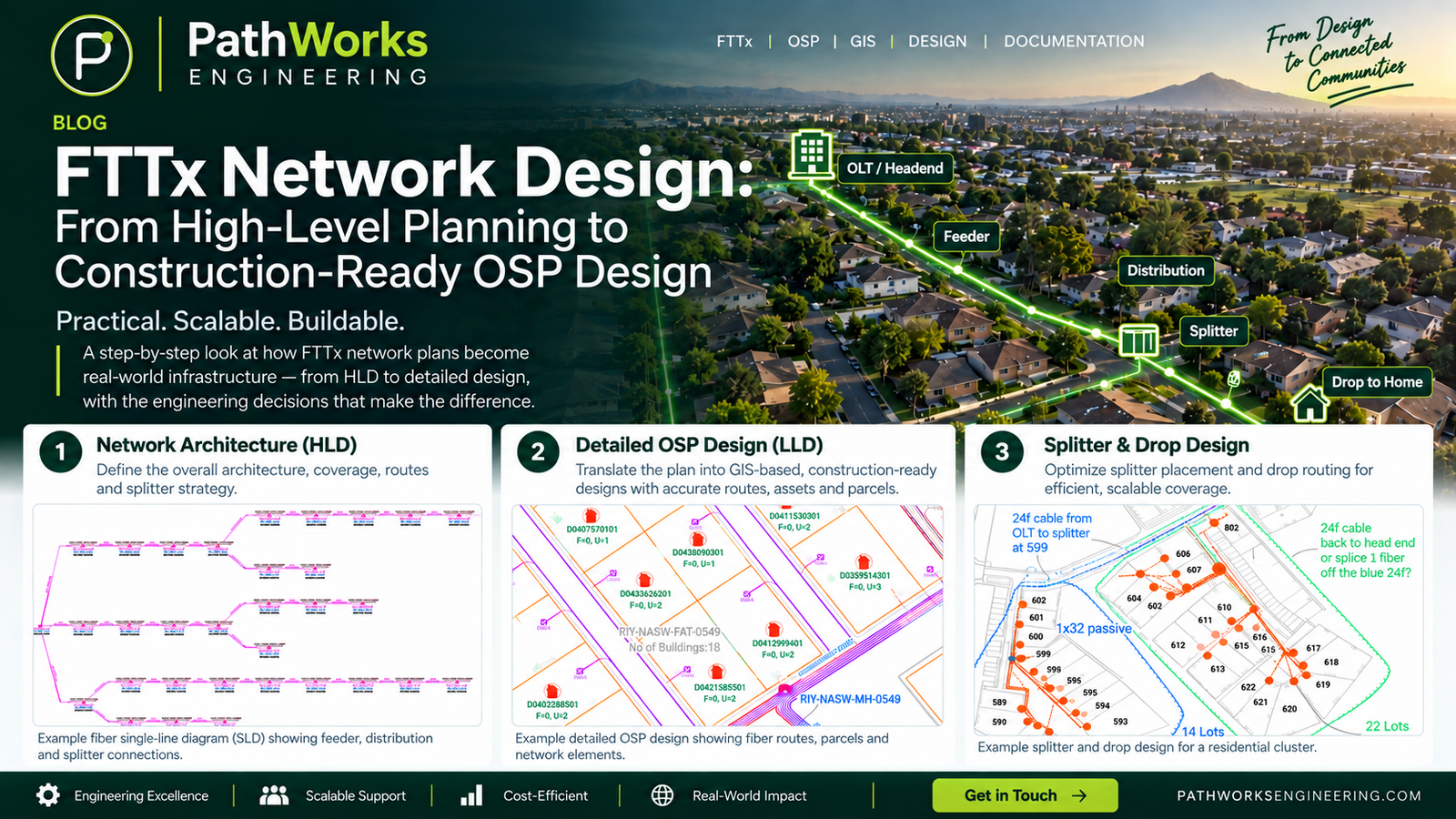

FTTx Network Design: From HLD to Construction-Ready OSP Engineering
A practical guide to FTTx network design, covering HLD, LLD, splitter planning, fiber topology, BOQ development, QA/QC and construction-ready OSP documentation.
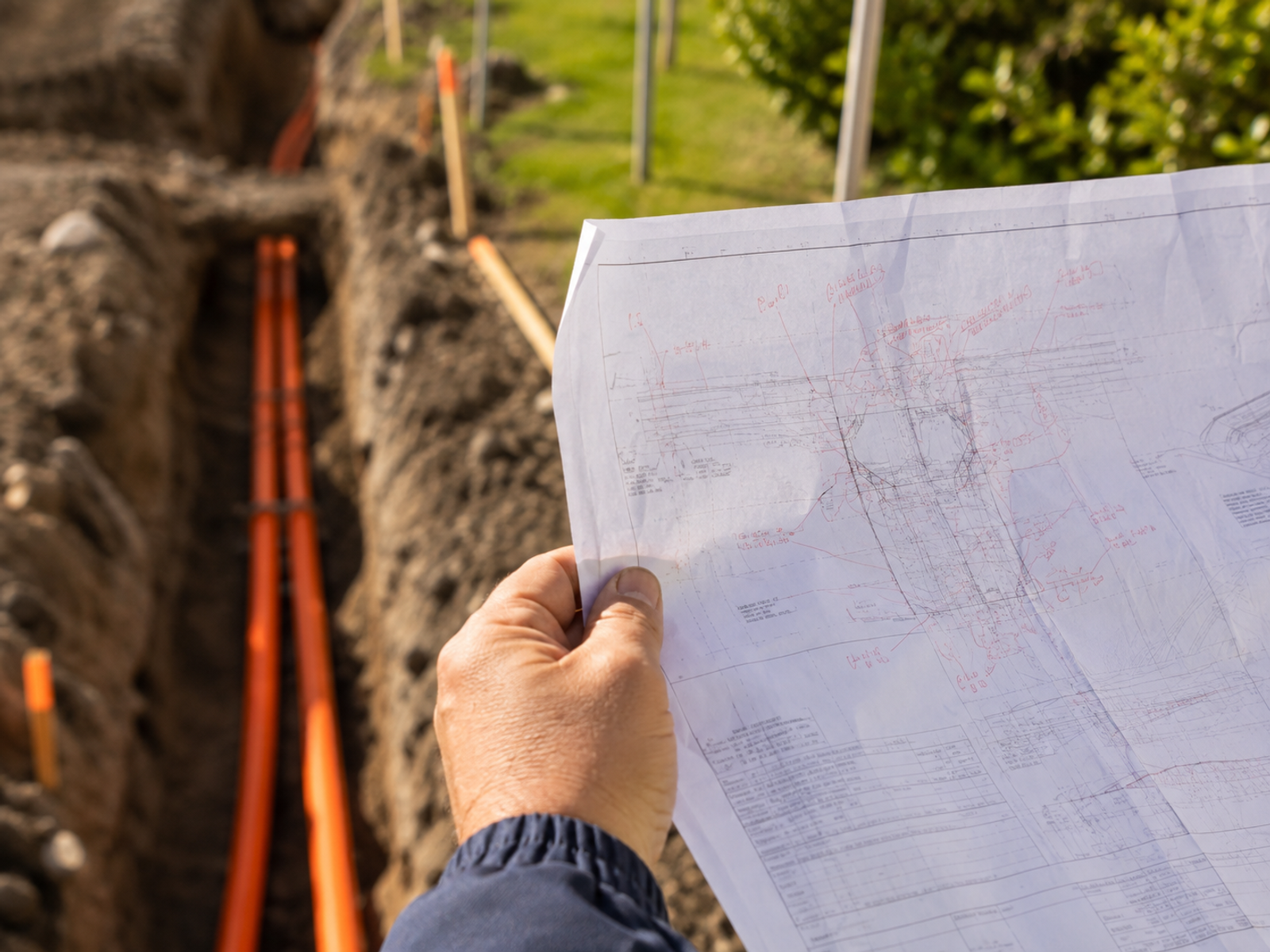
As-Built Redlining: Why the Built Network Stops Matching the Design, and How to Control the Drift
The network in the field and the network on the drawing start drifting apart the moment construction begins. Here's how to control that drift instead of discovering it years later.

GPON Power Budgets: Sizing Split Ratios Against Real Receiver Sensitivity, Not the Datasheet Ceiling
Sizing a split ratio off the datasheet ceiling looks fine on paper and fails in the field. Here's how to budget against real receiver sensitivity instead.